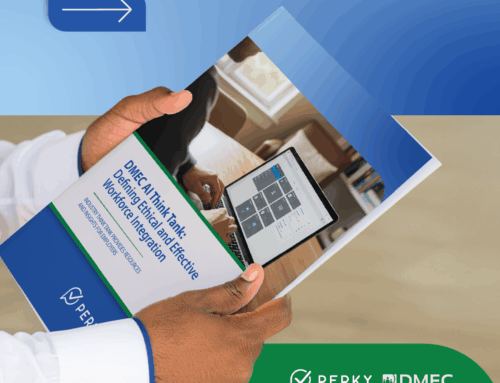
In early August, the 2025 DMEC Annual Conference in Washington, DC, brought together leaders across HR, benefits, and absence management to explore how we can better support employees through life’s biggest moments. For PERKY, it was an opportunity to share our vision, highlight new insights, and connect with the incredible professionals shaping the future of leave.
PERKY’s CEO, Shelby George, JD, CEBS, was an integral part of this year’s conference. She took the stage in two highly anticipated sessions: one focused on equipping managers to better support employees during leave, and another presenting findings from the PERKY-sponsored AI Think Tank. Both sessions underscored PERKY’s commitment to combining compliance with care and empowering people, not just processing claims.
Workshop Recap: The Untapped Role Managers Play in Leave
Shelby joined Jenny Merrithew, VP at Aflac, to co-lead an interactive session on the critical, yet often overlooked, role managers play in the leave process.
Managers are at the center of the leave experience, but too often they’re left without the tools, confidence, or clarity to navigate it well. In this workshop, attendees built employee and manager journey maps, identified key inflection points for support, and walked away with:
- Actionable strategies to train managers on empathy, compliance, and morale-building.
- Frameworks for employee-led communication.
- Practical tools to ensure continuity and care during absences.
The data is clear: Aflac’s 2025 Time Away Study shows that nearly 3 in 4 employees experience stress or anxiety while covering for a co-worker, and their well-being drops significantly during that time. A manager-supported, employee-led preparation process is not just a “nice-to-have”—it’s a business imperative.
AI Think Tank Findings: Defining the Future of AI in Absence Management
Shelby also joined DMEC CEO Bryon Bass to debut findings from the PERKY-sponsored AI Think Tank. This session highlighted where AI is emerging as a transformative force—and where caution is required.
Key insights included:
- Employers are increasingly separating claims management goals from employee education and experience goals—a vital step before evaluating AI solutions.
- The near-universal objective is to improve the employee experience with digital-first tools that are personalized, accurate, and secure.
- Many mid-sized employers (1k–15k employees) want automation and personalization, but aren’t ready to adopt AI or GenAI at scale.
Ultimately, the Think Tank findings underscored that compliance and care must go hand in hand as technology continues to evolve.
Conversations at the Booth: Elevating the Leave Experience
Beyond the sessions, some of our most meaningful moments came from the conversations at the PERKY booth. From HR leaders to leave managers, people leaned in to talk about the real challenges they’re facing—ensuring employees feel supported before, during, and after leave, while also keeping teams resilient and productive.
We heard firsthand how much it matters to have tools that:
- Visualize how federal, state, and employer benefits work together, so employees can clearly see how much time off they have and whether it’s paid.
- Facilitate communication between employees, managers, and colleagues to ease transitions and reduce stress.
- Support continuity planning so critical projects don’t stall when a key contributor steps away.
These conversations validated what we’ve long believed: leave is more than a claim—it’s a shared experience that shapes both culture and outcomes.
Looking Ahead
We left Washington, DC, in early August energized by the momentum in this space. Whether through manager-focused training, AI-driven insights, or innovative digital tools like PERKY Leave and PERKY Plan, the future of absence management is about empowering people, not just processing claims.
We’re grateful to everyone who joined our sessions, stopped by the booth, or shared their perspective. Together, we’re reimagining leave as a moment of growth, care, and connection—for employees, managers, and organizations alike.